Maya and Joe's house
Fool Me OnceMaya and Joe's house is the family home where Maya tries to resume caring for Lily after Joe’s burial, but its domestic rooms become inseparable from surveillance and uncertainty. A digital picture frame installed in the den appears to belong among the household’s family photographs and child-friendly furnishings; its concealed camera instead makes the room the setting for Maya’s sighting of her dead husband and, later, part of a calculated effort to unsettle her judgment.
Domestic Setting and Family Life
After the funeral, Eileen Finn drives Maya and Lily home. Lily has fallen asleep in her car seat, and Maya carefully works its complicated straps to lift her daughter out without waking her, cradling Lily’s head as she carries her inside. The small act of care gives the house an immediate purpose: it is where Maya must continue the routines of motherhood while confronting Joe’s absence. She has no words that feel adequate at his grave, and the return home offers no easy resolution; instead, she brings the practical demands of caring for Lily back into the space the couple shared.
The den, just off the kitchen, shows how the house has been rearranged around a young child. Its high cathedral ceiling and blond wood coexist with a large television, baskets overflowing with educational toys, and a Pack ’n Play set before the couch. A beautiful mahogany coffee table has been removed because it was not child-friendly. These details make the room a deliberately usable family space, organized around Lily’s play and care rather than preserved as a formal display of adult life. The contrast matters: the room’s welcoming, ordinary function will make the hidden camera there harder to distinguish from the objects that belong in a home.
The Picture Frame and the Den
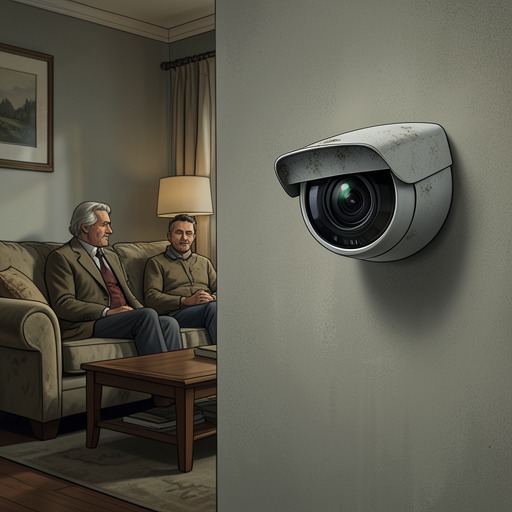
Eileen places a digital frame on the bookshelf and plugs it into an outlet. It has already been loaded with family photographs and is set to shuffle through them, giving the device an unremarkable domestic purpose. Eileen then turns it toward the area where Isabella and Lily usually play. The frame’s built-in wide-angle camera can see the whole room. Its placement is therefore practical as surveillance, even as its visible face presents a familiar sequence of family pictures.
The timing sharpens Maya’s unease about the device. The frame first appears the day after she has buried Joe, and she wonders whether Isabella, who is perceptive, might recognize that the new object has another purpose. Maya’s concern is not only whether the camera can record the room, but whether Isabella knows it is there and might alter her behavior. In that possibility, the frame’s usefulness depends on secrecy: if the nanny knows she is being watched, the surveillance may cease to reveal what Maya wants to know. The den’s ordinary arrangement for Lily’s play becomes a carefully watched field of action.
The Sighting and Its Immediate Consequences
When Maya reviews the recording on her computer, the image overturns the certainty on which she has been trying to live. She sees Lily crawl onto the lap of Joe, whom she believes to be dead. The footage is brief, but its setting gives it particular force: this is not an isolated image encountered elsewhere, but a figure apparently present in the home, in the room where Lily plays. The family space seems to offer direct evidence against the account of Joe’s death, even as the hidden camera makes the source of that evidence suspect.
Maya’s response is bodily before it becomes an explanation. She does not scream or gasp; instead, a spreading pressure across her chest makes breathing difficult, her veins feel cold, and her lips quiver. The recording turns a device meant to observe domestic life into a shock that invades it. Soon afterward, Maya concludes that someone has been inside the house and gone through Joe’s closet. Isabella arrives ten minutes later, offering the person Maya can question immediately. Isabella had reportedly watched Lily at the house the previous day and, in theory, should have noticed anything as unusual as Joe appearing in the room or playing with his daughter. The house is thus both the scene of the apparent return and the place where Maya tests whether the people around her could have witnessed it.
The House as Part of a Deception
Later, Maya weighs competing explanations for the nanny-camera image. She considers that it may have been fabricated with image-editing software, or that trauma, medication, guilt, and the events surrounding Joe and her sister may have distorted her perception. Neither possibility is established simply by the image itself. The recording’s apparent intimacy—Joe in the den with Lily—makes it emotionally potent, but does not settle whether what Maya saw was real.
Maya eventually tells Judith that the frame, the missing clothes, and the phone calls were among the things arranged to make her question her sanity and provoke her into investigating. She describes Caroline’s claims about her brothers being alive and Roger Kierce being on the family payroll as fabrications within the same psychological experiment. In this account, the house’s surveillance system is not merely a source of evidence: it is one component of a design meant to make Maya react, expose what she knows, and possibly incriminate herself. The camera’s domestic disguise therefore carries the central reversal of the location. A room furnished for family life becomes a stage for manufactured certainty, while the home that should distinguish the familiar from the threatening becomes the setting in which Maya is made to doubt both.